The road to general intelligence
Seventy-five years of ideas, breakthroughs, winters, and accelerations - traced through the milestones that brought the field to where it stands in 2026.
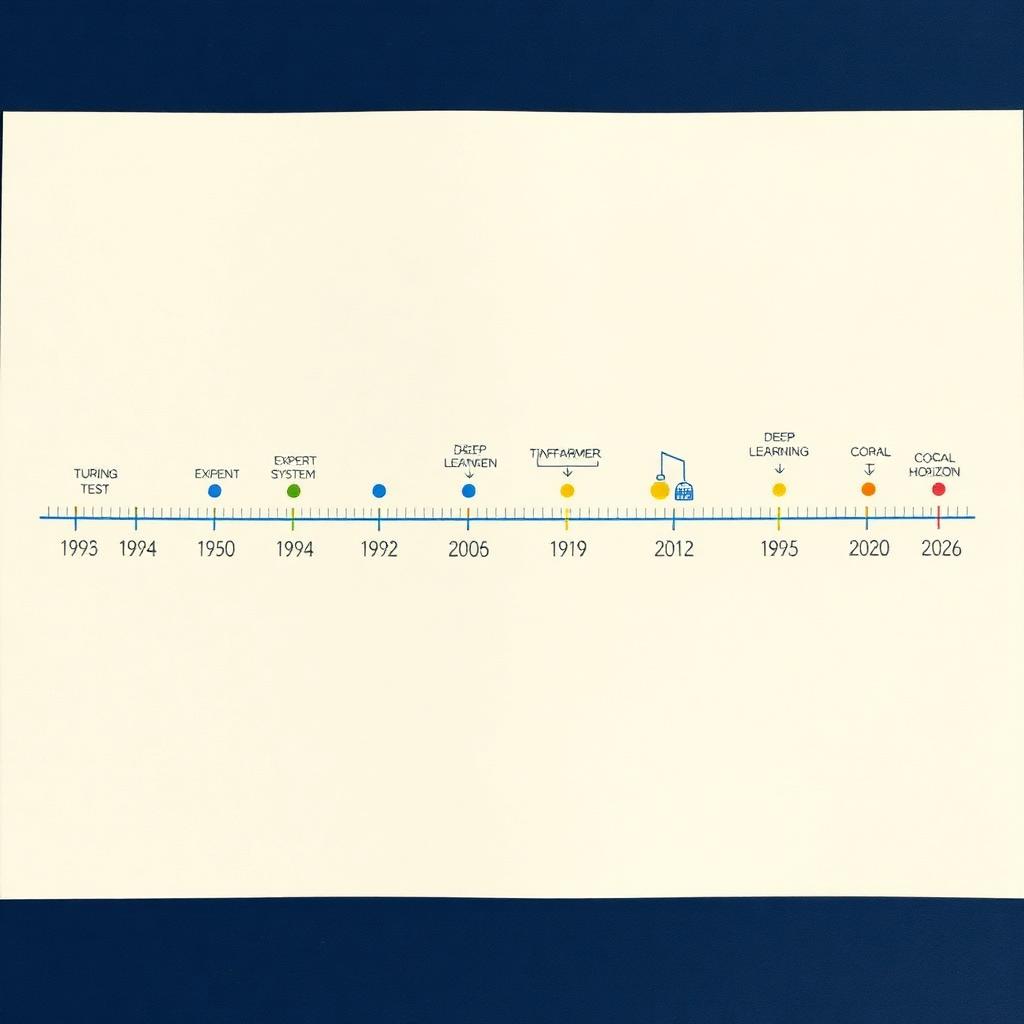
Timeline of milestones
Turing's Question
Alan Turing publishes Computing Machinery and Intelligence, asking whether machines can think and proposing the Imitation Game.
The Dartmouth Workshop
John McCarthy coins the term Artificial Intelligence; the field is formally founded.
Symbolic AI and Expert Systems
Rule-based systems encode human expertise. They scale poorly to messy, real-world domains.
Backpropagation
Rumelhart, Hinton, and Williams popularise backpropagation, making multi-layer neural networks trainable.
Deep Blue
IBM's chess engine defeats world champion Garry Kasparov - a milestone for narrow, specialised AI.
Deep Learning Revolution
GPU compute, large datasets, and improved architectures trigger rapid progress; AlexNet (2012) reshapes computer vision.
AlphaGo
DeepMind's reinforcement-learning system defeats Lee Sedol at Go - a domain long considered out of reach for machines.
Transformers
Vaswani et al. publish 'Attention Is All You Need', introducing the architecture behind today's large language models.
The Scaling Era
GPT, BERT, GPT-3, PaLM, Chinchilla and others demonstrate that capability scales predictably with compute, data, and parameters.
Generative AI Goes Public
ChatGPT, Stable Diffusion, and DALL-E bring generative models to hundreds of millions of users within months.
Multimodal Foundation Models
GPT-4, Gemini, Claude, Llama and others integrate text, image, audio, and code in a single model.
Reasoning Models
Systems trained with explicit chain-of-thought and reinforcement learning on reasoning traces achieve large gains on math, coding, and science benchmarks.
Frontier AGI Research
Labs converge on long-horizon agents, persistent memory, tool use, and self-correction as the remaining bottlenecks toward general capability.
Open Scenarios
Plausible paths include gradual continuity, capability discontinuities, hybrid neuro-symbolic systems, or new architectures we have not yet imagined.