The Intelligence Economy
When intelligence itself becomes cheap, abundant, and machine-produced, the structure of work, wealth, and innovation reorganises around it. This hub maps the economic dimension of AGI.
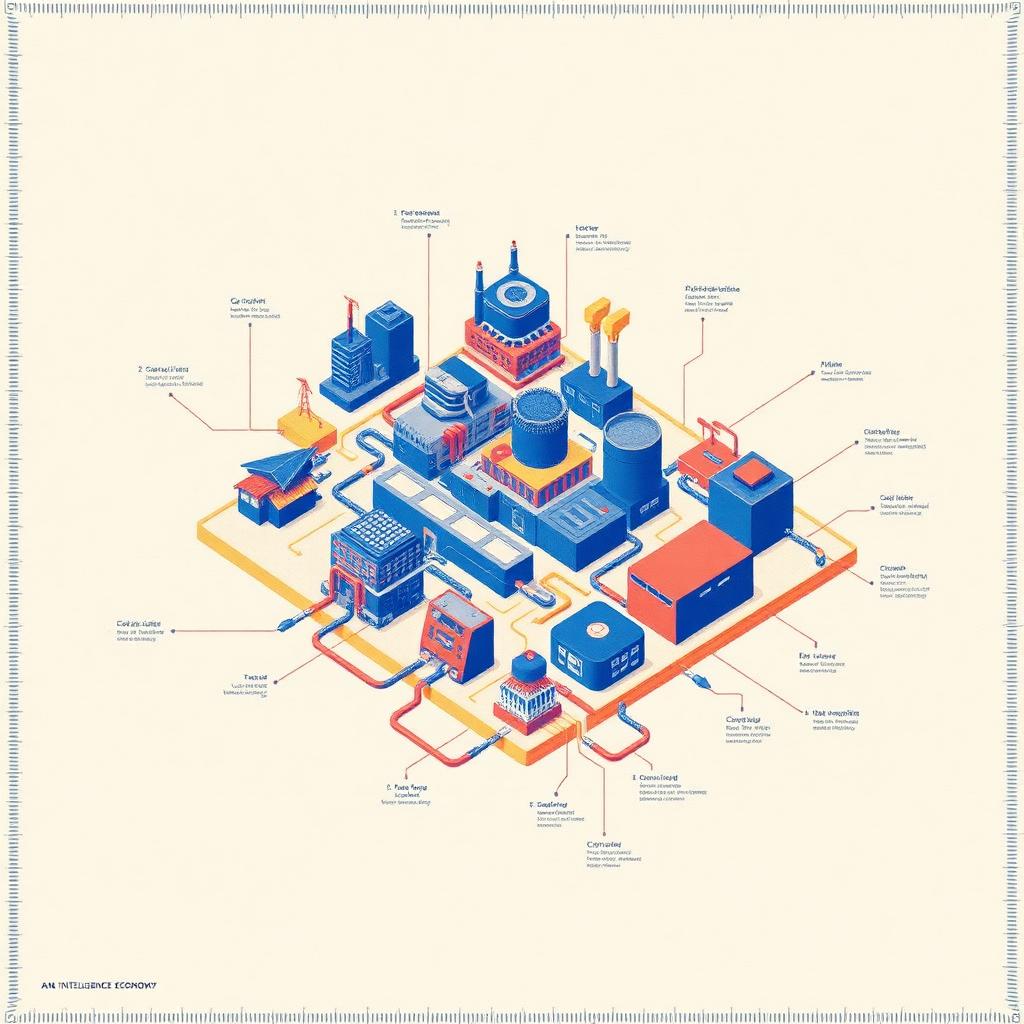
Cognitive Capital
The accumulated, productive cognitive capacity of a society - human skills, machine reasoning, and the tools that augment both.
Knowledge Economies
Economies whose value is dominated by information, expertise, software, and decision-making rather than physical goods.
Human Productivity
How AI tools shift the productivity frontier for knowledge workers, designers, scientists, and decision-makers.
AGI Economics
What happens to growth, wages, and capital when general reasoning becomes a tradeable commodity rather than a scarce human skill.
Automation
The historical pattern of automating routine work and the new pattern of automating cognitive, judgment-based work.
Future Labor Markets
How task composition, hiring, education, and lifelong learning are reshaping around AI-assisted workflows.
Innovation Systems
How AI tools accelerate R&D cycles, lower the cost of experimentation, and reorganise who can invent.
Digital Knowledge Work
The rise of work performed primarily through software, increasingly in collaboration with intelligent systems.
Every previous economy was constrained by how much human cognition it could mobilise.
If general-purpose machine reasoning becomes a commodity, that historical constraint dissolves. What replaces it - capital, energy, data, governance, or human judgment - is the open question of the intelligence economy.
Why frame it as an economy?
Intelligence has always had economic value. Education, expertise, consulting, science, and management are all markets for cognitive work. What changes with modern AI is the supply curve: reasoning that once required years of human training can increasingly be produced on demand, at falling unit cost, by software.
That shift touches every classical economic question - growth, distribution, labour, capital, comparative advantage - and adds new ones, such as how to govern the production of intelligence itself.
The vocabulary of the intelligence economy
Several overlapping terms describe this transition. Cognitive capitaland intellectual capital extend the older idea of human capital to include the stock of machine reasoning a society can deploy. The knowledge economy - a term popularised by Peter Drucker in 1969 and quantified in OECD reports through the 2000s - is now shading into an automation economy in which cognitive, not just physical, tasks are automated. AI economics and AGI economics ask what happens when the marginal cost of a unit of reasoning approaches the cost of inference compute. Daron Acemoglu and Simon Johnson's Power and Progress(2023) and Anton Korinek's work at Brookings sketch competing futures: broadly shared productivity gains, or a sharp split between owners of compute and everyone else.
Practically, this reshapes the future labor market for knowledge workers, the structure of intelligence markets for models and data, and the dynamics of the innovation economy as AI compresses R&D cycles. The headline measure to watch is cognitive productivity - output per hour of human + AI work - which is now rising fastest in software, customer support, translation, and parts of biomedical research.
Where this hub fits
Pair this hub with How AGI Could Change the World for sector impacts, Human + AI Collaboration for the workflow layer, and Future Intelligence for the longer time horizon.