Human + AI Collaboration
The most consequential near-term story is not AI replacing humans, but humans and AI working as integrated cognitive teams. The design choices made now will shape that relationship for decades.
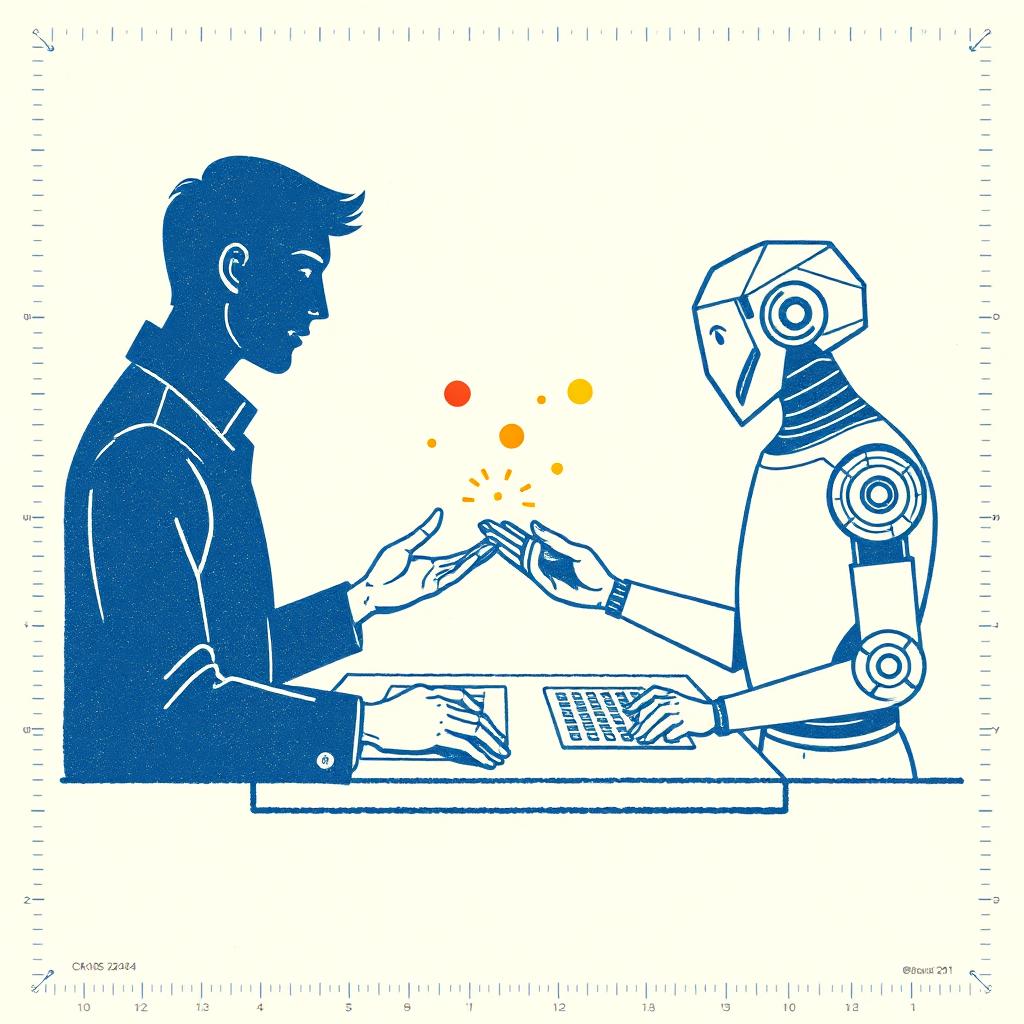
Augmented Intelligence
Designing AI to amplify human judgement rather than replace it - keeping the person as the locus of accountability and meaning.
Human-in-the-Loop Systems
Architectures where models propose and humans approve, edit, or veto. Critical in medicine, law, defense, and any high-stakes domain.
Cognitive Copilots
Always-available assistants that draft, summarise, critique, and remember context across knowledge work.
Decision Support Systems
Tools that surface relevant evidence, quantify uncertainty, and pre-empt cognitive biases without making the call.
Future Workplaces
Teams of humans and AI agents collaborating on long-horizon projects, with humans owning goals, taste, ethics, and stakeholder relationships.
Future Education
Tutoring that adapts to each learner's prior knowledge and pace - and curricula that emphasise the uniquely human skills AI does not provide.
Future Creativity
Generative tools as instruments. The interesting question is no longer whether AI can make art, but what humans choose to make with it.
Designing for complementarity
Humans and current AI systems have asymmetric strengths. AI offers breadth, speed, tireless attention, and recall. Humans offer judgement under ambiguity, embodied context, moral reasoning, and accountability. Good collaboration design plays each to its strengths rather than forcing one to imitate the other.
What this looks like in practice
- Pair-programming with code models that explain their reasoning.
- Radiologists reading scans pre-screened by image models.
- Teachers using tutoring models as a force-multiplier across class sizes.
- Researchers using literature agents to map the frontier of a subfield.
- Writers using language models to draft, critique, and stress-test ideas.
Augmented intelligence, copilots, and human-in-the-loop work
Human AI collaboration is the umbrella for a fast-growing design space. Augmented intelligence and intelligence augmentation describe systems built to extend a person's reach; AI copilots apply that idea to specific workflows - GitHub Copilot for code, Microsoft 365 Copilot for documents, Google's Gemini in Workspace, Adobe Firefly in creative tools. Human in the looparchitectures keep a person at the point of decision in safety-critical domains: radiology, drug discovery, legal review, financial underwriting.
The empirical evidence on AI productivity is no longer anecdotal. A 2023 MIT study by Noy and Zhang found mid-level professionals completed writing tasks ~40% faster with ChatGPT while quality scores rose; a 2023 NBER study of 5,000 customer-support agents by Brynjolfsson, Li, and Raymond found a 14% productivity gain concentrated among less experienced workers; GitHub's controlled trials reported developers finishing tasks 55% faster with Copilot. These are early signals, but they consistently point to a complementarity pattern - AI assisted decision making that lifts the floor more than the ceiling.
The longer arc points toward hybrid intelligence and human machine collaboration: teams in which humans and AI agents share tasks, context, and accountability. Designing those teams well - human centered AI, cognitive augmentation rather than replacement - is what will shape the future of work and the AI workforce through the late 2020s.