The History of AGI Research: From Dartmouth to 2026
A concise history of artificial general intelligence as a research goal — from the 1956 Dartmouth Workshop, through the AI winters, to the modern era of frontier models.
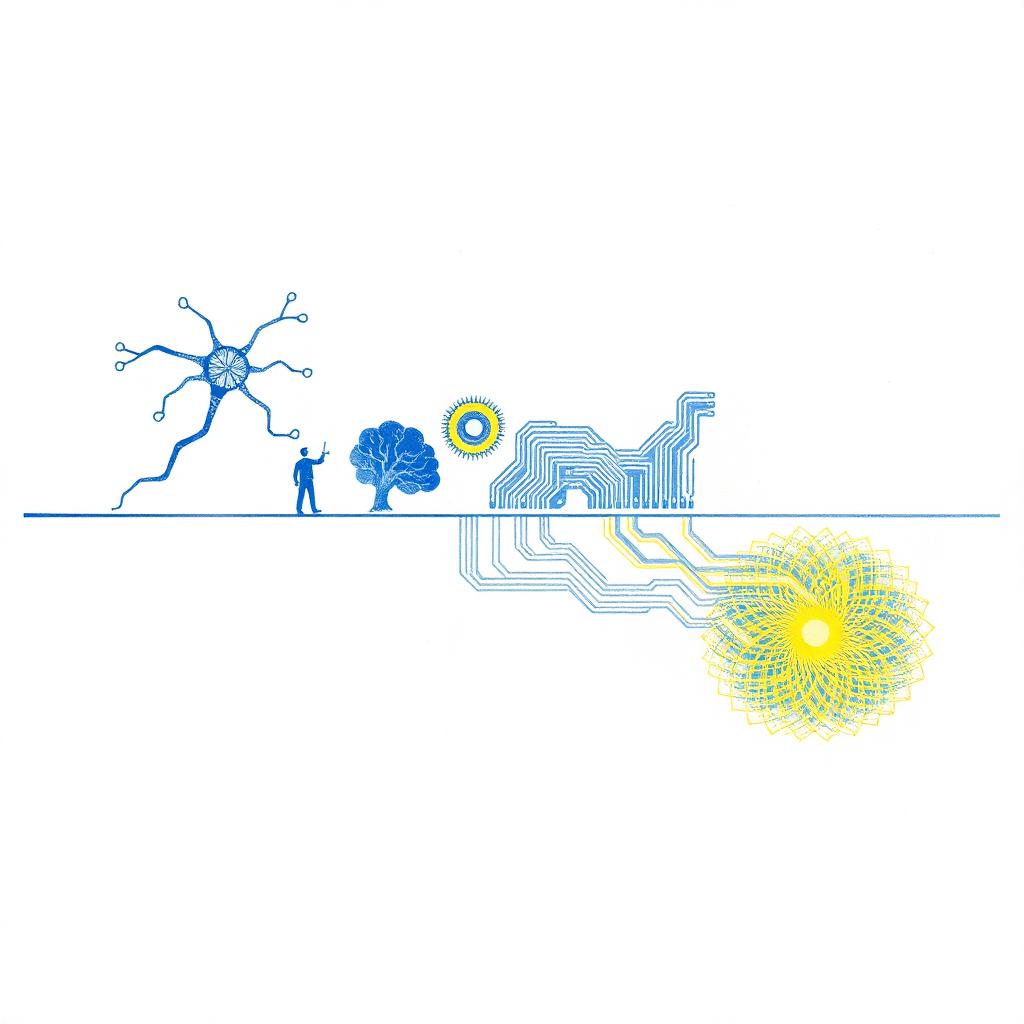
Executive summary
Artificial general intelligence has been the field's animating goal since the 1956 Dartmouth Summer Research Project on Artificial Intelligence. Progress has come in waves separated by AI winters. The current wave — driven by scale, transformers, and reinforcement learning — has put the goal back on the agenda of every major laboratory.
Key concepts
- Dartmouth Workshop (1956)
- Symbolic AI era
- AI winters
- Deep learning revolution
- Transformer architecture
- Frontier era
Origins (1956–1973)
The 1956 Dartmouth Workshop, organised by John McCarthy, Marvin Minsky, Claude Shannon, and Nathaniel Rochester, coined the term artificial intelligence and set general intelligence as the field's goal. Early systems like Logic Theorist and General Problem Solver attempted symbolic reasoning over hand-crafted rules.
The AI winters (1974–1993)
Two long funding contractions followed when symbolic systems failed to scale. Computing power, data, and theoretical frameworks were not yet sufficient. The first winter began after the Lighthill Report in 1973; the second followed the collapse of the expert-system industry in the late 1980s.
The machine-learning era (1994–2011)
Statistical approaches and improved hardware revived progress. Support vector machines, ensemble methods, and probabilistic graphical models displaced rule-based systems. Narrow benchmarks fell — chess (Deep Blue, 1997), driving challenges (DARPA Grand Challenge, 2005), and Jeopardy! (IBM Watson, 2011).
The deep-learning revolution (2012–2017)
AlexNet's 2012 ImageNet win demonstrated that deep neural networks plus GPUs plus large data sets could dominate perception tasks. DeepMind's AlphaGo defeated Lee Sedol in 2016. The 2017 paper Attention Is All You Need introduced the transformer, which underlies every frontier model since.
The frontier era (2018–2026)
GPT-3 (2020), ChatGPT (2022), GPT-4 (2023), and reasoning models including OpenAI's o-series (2024–25), Claude with extended thinking, Gemini 2.x, and DeepSeek-R1 returned AGI to the centre of the discourse. The UK AI Safety Summit (2023), the EU AI Act (in force August 2024), and the International AI Safety Report (2025) formalised the policy response.
Key takeaways
- 01AGI has been the field's stated goal since 1956.
- 02Two AI winters followed when expectations outran capability.
- 03Modern progress came from scale, transformers, and reinforcement learning together.
- 04Policy frameworks now treat advanced general-purpose AI as a serious near-term concern.
Frequently asked questions
Why were the AI winters?
Symbolic systems and shallow neural networks could not scale to real-world complexity given the data and compute then available.
What changed in 2012?
AlexNet showed that deep networks plus GPUs plus large datasets dramatically outperformed prior methods on vision benchmarks.
What is the significance of transformers?
Transformers enable efficient learning over very long sequences and underpin every frontier LLM since 2018.